
Description:
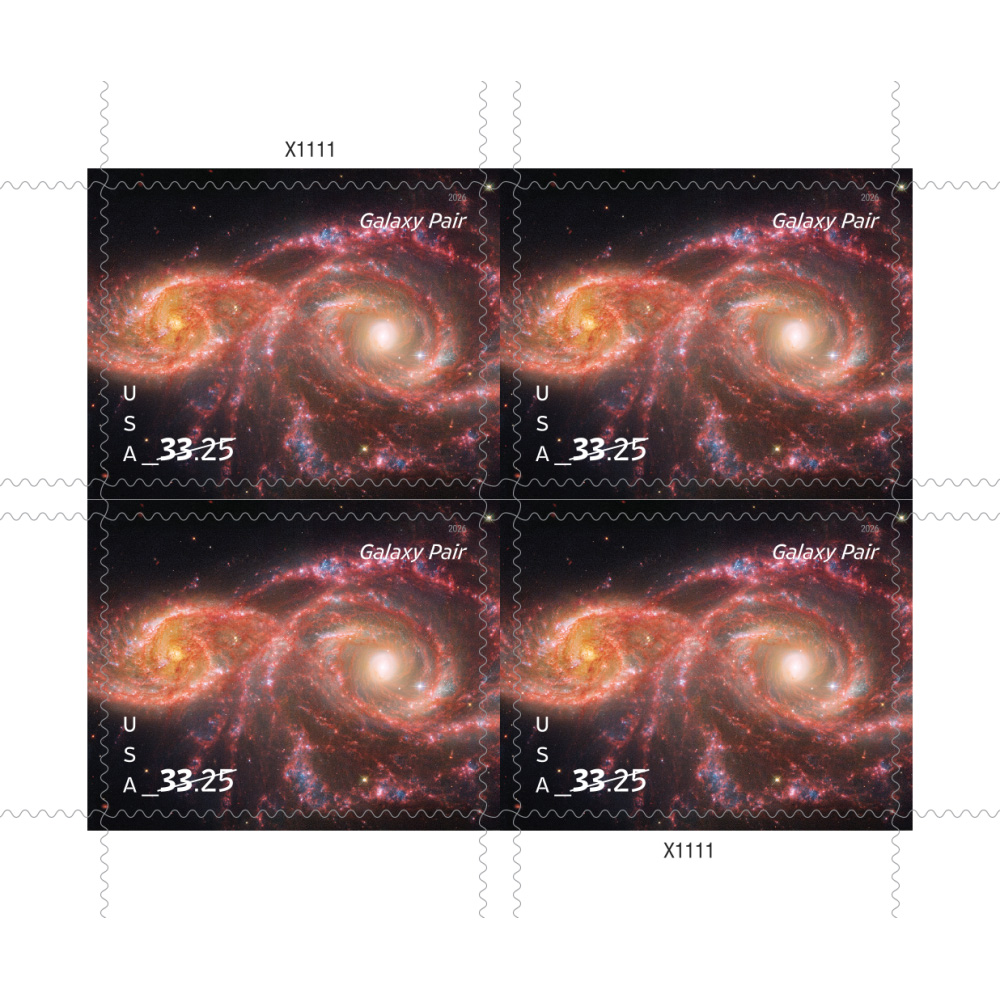
Continuing a tradition of celebrating astronomical discoveries and the wonder of space exploration, the U.S. Postal Service unveils a new Priority Mail Express® stamp showcasing a composite James Webb Space Telescope (Webb) and Hubble Space Telescope image titled Galaxy Pair. This image reveals two adjacent galaxies’ sweeping spiral arms, bright star-forming regions, and clouds of dust and gas, offering a glimpse into the dynamic processes that shape our universe.
This stamp follows previous USPS releases featuring James Webb Space Telescope images, including the Cosmic Cliffs and Pillars of Creation stamps issued in 2024, and the Spiral Galaxy and Star Cluster stamps in 2025.
Art director Greg Breeding, who has overseen the design of all previous Priority Mail® and Priority Mail Express® Webb-themed stamps, again led the artistic direction for the Galaxy Pair stamp.
“When I first came across this image, it took my breath away,” he says. “The image is so powerful and dynamic—I knew it had to become a stamp.”
The Galaxy Pair image presents a stunning view of two interacting galaxies, IC 2163 and NGC 2207, located approximately 80 million light-years from Earth. These galaxies are engaged in a cosmic dance, their mutual gravitational forces distorting their shapes and triggering waves of star formation.
The image of the two galaxies is a composite of separate exposures acquired by the Hubble and James Webb space telescopes using advanced imaging technology.
In Hubble’s original image, the star-filled spiral arms glow brightly in blue, and the galaxies’ cores appear in orange.
In Webb’s image, cold dust takes center stage, casting the galaxies’ arms in white. Areas where stars are still deeply embedded in the dust appear pink. Other pink regions may be objects that lie well behind these galaxies, including active supermassive black holes known as quasars.