
Description:
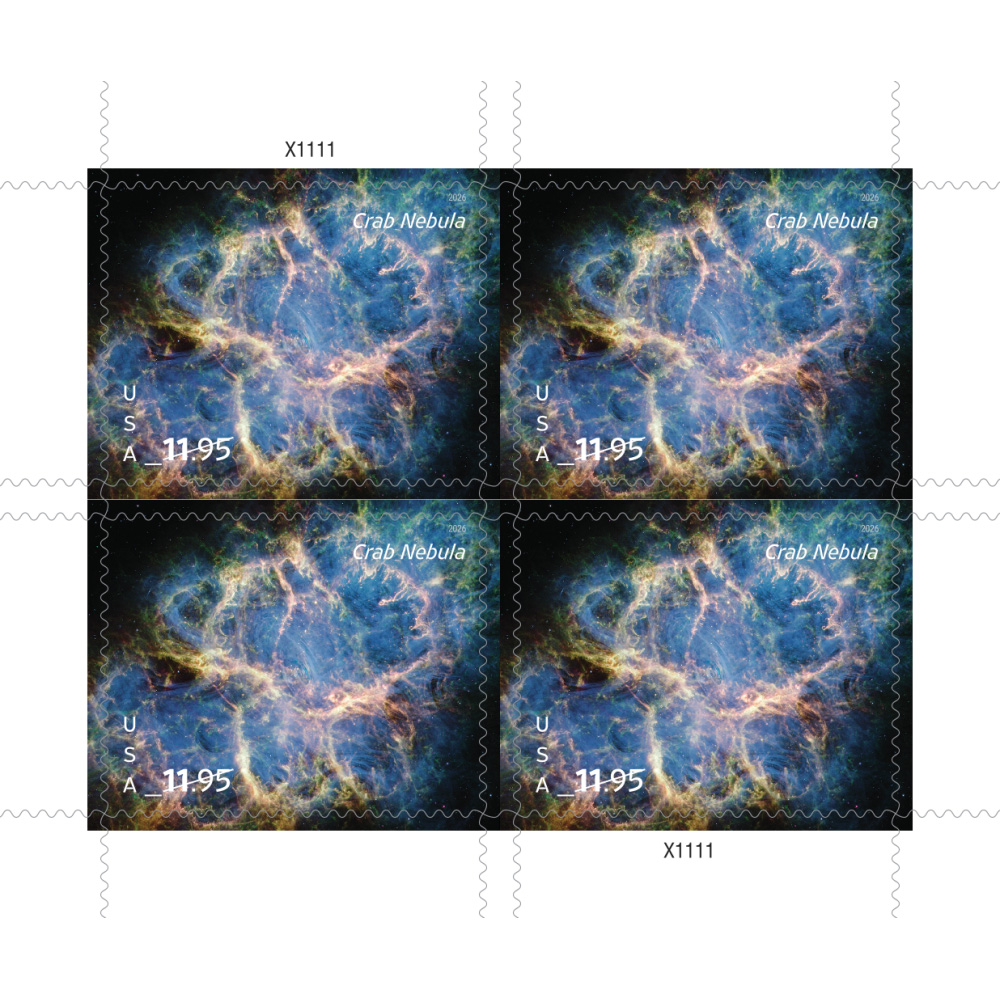
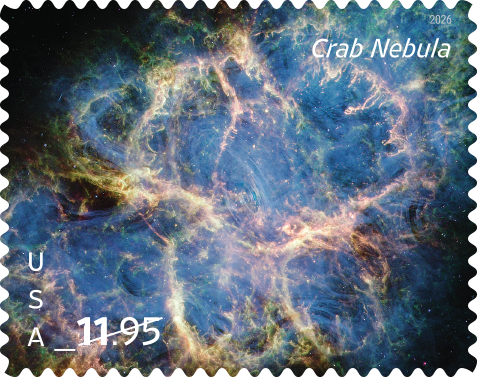
Celebrate the wonders of the universe with a new Priority Mail® stamp featuring James Webb Space Telescope’s (Webb) magnificent image of the famed Crab Nebula. One of the most frequently observed celestial bodies, the Crab Nebula is one of the brightest remnants of an exploded star in the night sky. Webb’s discoveries are reshaping our knowledge of galaxies, exoplanets, and the formation of stars, continuing the legacy of previous space telescopes like Hubble.
Designed by USPS art director Greg Breeding, this stamp highlights the marvel of engineering that is Webb, an observatory designed to study some of the oldest and most distant objects in space.
“Crab Nebula is one of the most famous, and beautiful, objects in space,” says Breeding. “When choosing an image from NASA’s collection, it stood out among others because of its eye-catching color and shape. It fits perfectly on a stamp and will be recognizable to many.”
The star that created the Crab Nebula—also known as Messier 1 (M1)—exploded in 1054, prompting Chinese astronomers to note a "guest star" in the night sky. Because the supernova was so bright at the time, it was likely observed by humans all over the world. Its light would have been comparable to the full moon—six times brighter than Venus.
On June 17, 2024, NASA released this striking new Webb image of the Crab Nebula, offering a fresh perspective on one of the most famous supernova remnants. Located 6,500 light-years away in the constellation Taurus, Webb captured the new Crab Nebula image in vivid infrared detail using its powerful sensors.
Webb’s infrared instruments provide previously unseen details of its intricate filaments and glowing clouds. Dust, shown in fluffy magenta (pink-purple), forms a cage-like shape that stands out in the bottom left and top right areas of the image. There are also threads of dust inside the remnant, and some of them match up with green-colored areas made of ionized sulfur. Yellow-white lines form big looping shapes near the center—these are spots where the dust and sulfur mix.
This cage-like dust structure partly holds in a ghostly blue glow called synchrotron emission, which looks like wisps of smoke. This glow is caused by the Crab Nebula’s central pulsar, a fast-spinning dead star with a strong magnetic field. The blue lines follow that magnetic field, creating a smoky, ribbon-like effect.